
Forest Inventories Services for Habitat Assessment & Land Management
Volant EcoServices provides comprehensive forest inventory services to assess the structure, composition, and ecological condition of forested ecosystems across Ohio, Pennsylvania, Kentucky, West Virginia, Indiana, Virginia, and the broader eastern United States. Our inventories are designed to support land management decisions, conservation planning, habitat assessments for sensitive and listed species, and environmental permitting across a wide range of project types and scales.
Our field teams collect detailed data on tree species composition, diameter at breast height (DBH), canopy cover, stand age and structure, understory vegetation, snag density, regeneration, and signs of disturbance or disease — following standardized forestry protocols that ensure consistency, accuracy, and compatibility with state and federal agency requirements. This data provides the ecological foundation for understanding how forested landscapes function and how they may be affected by proposed development, management activities, or conservation interventions.
Forest inventories are particularly valuable for evaluating bat habitat quality. Forest stand age, snag density, canopy closure, and the presence of trees with cavities or exfoliating bark are critical variables for assessing the suitability of forested areas for roosting Indiana bat (Myotis sodalis), northern long-eared bat (Myotis septentrionalis), tricolored bat (Perimyotis subflavus), and other bat species. When integrated with bat surveys and habitat assessments, forest inventory data provides a complete, defensible picture of forest conditions that directly informs ESA compliance and Section 7 consultation outcomes.
Stand Structure & Composition Assessments
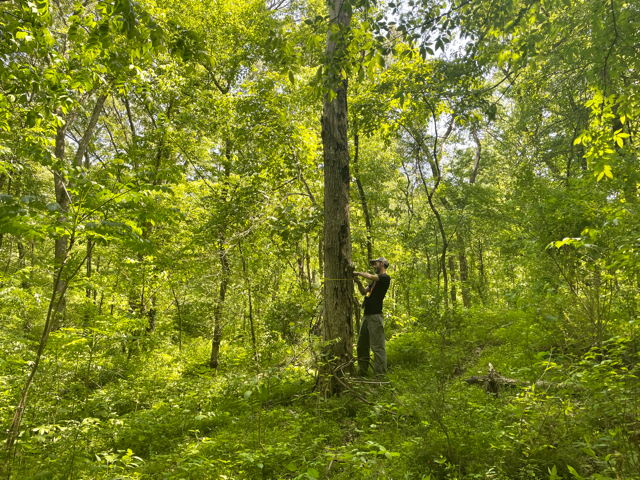
Stand structure and composition assessments document the physical and biological characteristics of a forest stand — the building blocks of any comprehensive forest inventory. These assessments capture tree species diversity, diameter class distributions, basal area, canopy layering, and the relative abundance of mast-producing, cavity-bearing, and snag trees that provide critical wildlife habitat.
Volant conducts stand structure assessments using fixed-radius plot sampling, variable-radius point sampling, and line-intercept transect methods appropriate to project objectives and forest conditions. Our ecologists have extensive experience working in the mixed hardwood, oak-hickory, bottomland, and upland forest types common across the eastern United States, and understand how stand structural characteristics relate to habitat suitability for listed bat species, area-sensitive forest birds, and other wildlife of regulatory concern. Stand composition data is reported in formats compatible with state and federal agency requirements and suitable for integration into environmental assessments, biological evaluations, and conservation plans.
Roost Tree & Bat Habitat Assessments
Forest inventory data plays a direct role in ESA compliance for projects that may affect listed bat species. Indiana bat, northern long-eared bat, and tricolored bat all rely on specific forest structural features for roosting — including large-diameter trees with loose or exfoliating bark, cavities, crevices, and other features that provide suitable microclimate conditions for maternity colonies and individual roost bats.
Volant integrates roost tree assessments into forest inventory work, systematically documenting the presence, density, and condition of potential roost trees within project areas. This data directly informs presence/probable absence survey design, roost tree removal protocols, work window determinations, and tree clearing plans required for ESA compliance. For projects involving tree clearing near suitable bat habitat, our roost tree assessments provide the foundation for determining what surveys are needed, what trees require pre-clearing emergence surveys, and what mitigation or avoidance measures may be appropriate. Our roost tree data is also used to support potential hibernaculum surveys by identifying forested features that may provide transitional roost habitat near hibernacula.
Snag & Coarse Woody Debris Assessments
Snags — standing dead or dying trees — and coarse woody debris are among the most ecologically valuable structural elements in forested landscapes. They provide critical roosting habitat for bat species, nesting cavities for birds, shelter for reptiles and amphibians, and substrate for invertebrates and fungi that support broader forest food webs. Documenting snag density, size class, and decay stage is a standard component of wildlife habitat assessments and is often specifically required in NEPA documents and biological assessments for projects affecting forested areas.
Volant quantifies snag density and coarse woody debris volumes as part of comprehensive forest inventory programs, providing clients and agencies with standardized data on these critical habitat features. Our snag assessments follow wildlife agency protocols and are reported in formats compatible with habitat suitability models and conservation planning tools. For projects involving threatened and endangered species with forest habitat dependencies, snag data is a key input for habitat quality evaluations and mitigation planning.
Forest Health & Disturbance Assessments
Forest health assessments evaluate the condition of a forested stand in relation to natural disturbance processes, pest and disease pressures, invasive species encroachment, and the cumulative effects of land use history. Understanding forest health conditions is critical for land managers making decisions about timber harvesting, restoration, invasive species control, and long-term habitat management — and for environmental consultants assessing the baseline condition of forested project areas.
Volant conducts forest health assessments documenting the incidence and severity of pest and disease damage, including threats such as emerald ash borer, beech leaf disease, oak wilt, and hemlock woolly adelgid that are significantly altering forest composition across the eastern United States. We also evaluate the cover and distribution of invasive plant species — including multiflora rose, Japanese barberry, autumn olive, and garlic mustard — that can suppress native understory regeneration and degrade habitat quality for forest-dependent wildlife. Assessment results inform forest management recommendations, restoration planning, and conservation strategies tailored to the specific conditions and goals of each project.
Carbon Stock Estimation & Forestry Compliance
Forest inventories provide the foundational data needed for carbon stock estimation, supporting forest carbon offset projects, voluntary conservation commitments, and regulatory compliance with forestry best management practices. Accurate, field-verified measurements of tree species composition, diameter, height, and stand density are required inputs for carbon accounting methodologies used by major voluntary carbon markets and state and federal forestry programs.
Volant supports carbon stock estimation by collecting the field inventory data needed to calculate above-ground biomass and carbon stocks using standard allometric equations and agency-accepted methodologies. We work with landowners, conservation organizations, and land managers to provide the forest measurement data needed to establish baseline carbon stocks, monitor changes over time, and document compliance with forestry stewardship standards. Our work follows established protocols compatible with major carbon registry requirements and state forestry program standards across the eastern United States.
Long-Term Forest Monitoring
Long-term forest monitoring programs track changes in stand structure, species composition, regeneration success, and habitat quality over time — providing the ecological trend data needed for adaptive management, conservation planning, and regulatory compliance reporting. Monitoring programs are increasingly required as a condition of conservation easements, mitigation banking agreements, habitat conservation plans, and restoration project grants.
Volant designs and implements long-term forest monitoring programs using permanent plot networks, standardized measurement protocols, and consistent data collection procedures that allow meaningful trend analysis across monitoring intervals. Our monitoring programs are built to meet the specific reporting requirements of conservation easement holders, mitigation bank sponsors, grant agencies, and regulatory programs. We provide clear, well-documented annual or periodic monitoring reports that demonstrate progress toward management goals and fulfill compliance obligations — giving landowners, agencies, and funders confidence in the ecological trajectory of their forested lands.
Ready to discuss forest inventory or habitat assessment needs for your project or property? Contact Volant EcoServices to speak with our team about forest inventory services across Ohio, Pennsylvania, Kentucky, West Virginia, Indiana, and the eastern United States.