Wetland & Stream Delineations and Section 404 Permitting
Wetlands and streams are among the most regulated natural features in the United States, and projects that affect them — even indirectly — require early, accurate identification of jurisdictional boundaries and a clear understanding of applicable permitting requirements. Volant EcoServices conducts wetland and stream delineations, jurisdictional determinations, and Section 404 permitting support for land developers, infrastructure contractors, transportation agencies, energy companies, conservation organizations, and private landowners across Ohio, Pennsylvania, Kentucky, West Virginia, Indiana, Virginia, and the broader eastern United States.
Our wetland scientists conduct field delineations in accordance with the U.S. Army Corps of Engineers (USACE) 1987 Wetland Delineation Manual and applicable regional supplements, producing defensible, agency-ready documentation that supports project planning, permit applications, and regulatory compliance under Section 404 of the Clean Water Act. We combine field expertise with thorough regulatory knowledge to help clients identify jurisdictional constraints early, minimize project impacts, and navigate the permitting process efficiently.
What Is a Wetland Delineation?
A wetland delineation is a field-based investigation that establishes the precise location, extent, and boundaries of wetlands and other waters of the United States within or adjacent to a proposed project area. The USACE requires wetland delineations for projects that may involve the discharge of dredged or fill material into jurisdictional waters — including wetlands, streams, ponds, ditches, and other surface water features — before Section 404 permits can be issued.
Wetland delineation relies on the identification of three parameters that must all be present for an area to qualify as a jurisdictional wetland under the USACE 1987 Manual:
- Hydrophytic vegetation — plant species adapted to grow in saturated or flooded soil conditions
- Hydric soils — soils that have formed under conditions of saturation, flooding, or ponding long enough to develop anaerobic conditions
- Wetland hydrology — evidence of surface or near-surface water presence for sufficient duration during the growing season
When all three criteria are met, the area is delineated as a jurisdictional wetland and its boundaries are flagged in the field, GPS-located, and mapped for inclusion in a formal delineation report. Where one or more criteria are absent, the area is documented as upland and excluded from regulated boundaries.
Stream Delineations & Ordinary High Water Mark
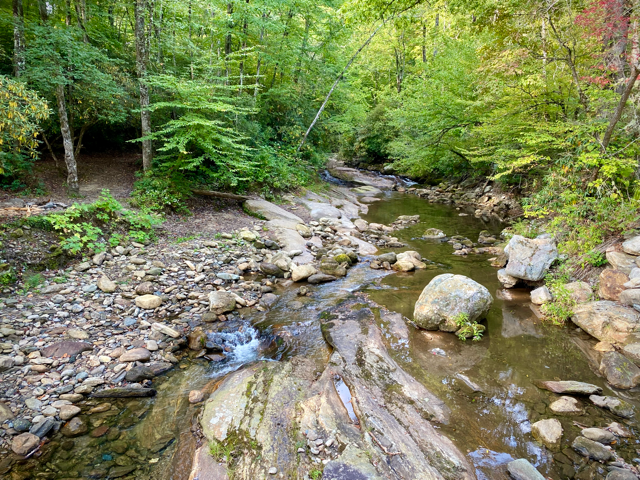
In addition to wetland delineations, Volant conducts stream delineations to identify and map regulated stream channels, ditches, and drainage features within project areas. Stream delineations establish the Ordinary High Water Mark (OHWM) — the line on the bank or shore to which the presence and action of surface water is so continuous as to leave a distinct mark — which defines the lateral extent of USACE jurisdiction over non-tidal streams and rivers.
Stream delineation is particularly important for linear infrastructure projects — pipelines, transmission lines, roadways, and utility corridors — where project footprints cross multiple stream channels and each crossing may require individual Section 404 authorization or Nationwide Permit coverage. Accurate stream delineation early in the project planning process allows project designers to identify crossing locations, minimize jurisdictional impacts, and select the most efficient permitting pathway before construction plans are finalized.
Jurisdictional Determinations
A jurisdictional determination (JD) is a formal USACE decision about whether waters, wetlands, or other features on a site are subject to Clean Water Act jurisdiction. Volant prepares Approved Jurisdictional Determination (AJD) requests and Preliminary Jurisdictional Determination (PJD) documentation for submission to the appropriate USACE District, providing the delineation data, mapping, and supporting analysis that USACE field staff need to make regulatory determinations.
Obtaining an AJD establishes a legally binding five-year determination of jurisdictional status that provides project proponents with certainty about which features on their site require Section 404 permitting — and, equally importantly, which features do not. For projects where schedule certainty is critical, securing an AJD early in the design process can prevent costly mid-project regulatory surprises and streamline the path to permit approval.
Section 404 Permitting Support
Once jurisdictional features are identified and mapped, projects that propose impacts to waters of the United States require authorization from the USACE under Section 404 of the Clean Water Act. Volant provides full Section 404 permitting support, helping clients select the most appropriate permit pathway, prepare permit applications, and coordinate with the USACE and state agencies throughout the review process.
Nationwide Permits (NWPs) — Nationwide Permits provide streamlined authorization for activities with minimal individual and cumulative impacts. Volant assesses whether a proposed project qualifies for NWP coverage, prepares pre-construction notifications (PCNs) where required, and documents compliance with general and regional conditions to support NWP verification by the USACE District.
Individual Permits (IPs) — Projects that do not qualify for Nationwide Permit coverage — typically those involving more significant impacts to jurisdictional waters — require Individual Permit review, which involves public notice, agency coordination, and a more extensive environmental review process. Volant prepares Individual Permit applications, including impact assessments, alternative analyses, and mitigation proposals, and supports clients through the full Individual Permit review process.
Section 401 Water Quality Certification — Section 404 permits also require water quality certification from the relevant state environmental agency under Section 401 of the Clean Water Act. Volant coordinates Section 401 certification requests with the Ohio EPA, Kentucky Energy and Environment Cabinet, West Virginia Department of Environmental Protection, Pennsylvania Department of Environmental Protection, Indiana Department of Environmental Management, and other state agencies across our service area.
Wetland & Stream Functional Assessment
Not all wetlands and streams are ecologically equivalent, and regulatory agencies increasingly consider functional quality — not just jurisdictional area — when evaluating proposed impacts and required mitigation. Volant conducts functional assessments of wetlands and streams using standard methodologies including the Hydrogeomorphic (HGM) approach and the Rapid Assessment of Stream Quality (RASQ), providing clients and agencies with a defensible evaluation of the ecological functions and values of features that may be affected by a proposed project.
Functional assessment data informs compensatory mitigation requirements — the amount and type of replacement habitat that must be provided to offset permitted wetland and stream impacts — and can be used to demonstrate that proposed project designs minimize functional losses. For projects where mitigation is unavoidable, functional assessment data supports the development of mitigation ratios and the selection of appropriate mitigation mechanisms including mitigation banks, in-lieu fee programs, and permittee-responsible mitigation.
Compensatory Mitigation Support
When Section 404 permits authorize unavoidable impacts to jurisdictional wetlands and streams, the USACE requires compensatory mitigation to replace lost functions and values. Volant assists clients in evaluating mitigation options and developing compensatory mitigation strategies that satisfy USACE requirements while minimizing project costs and schedule impacts.
Mitigation options include the purchase of wetland or stream mitigation bank credits, payment to USACE-approved in-lieu fee programs, or the design and implementation of permittee-responsible mitigation sites — including wetland creation, enhancement, or restoration on lands permanently protected from future development. Volant evaluates the availability and cost of mitigation bank credits within applicable service areas, assists with in-lieu fee program coordination, and can support the design and monitoring of permittee-responsible mitigation sites as needed.
Integration with Bat Surveys & ESA Compliance
Wetland and stream habitats are not evaluated in isolation at Volant EcoServices. Riparian corridors, forested wetlands, and stream channels are among the most productive foraging and commuting habitats for federally listed bat species — including the Indiana bat (Myotis sodalis), northern long-eared bat (Myotis septentrionalis), and tricolored bat (Perimyotis subflavus). Projects that require wetland delineations and Section 404 permits frequently also require bat surveys and ESA Section 7 consultation for listed bat species.
Volant's ability to conduct both wetland delineations and bat presence/probable absence surveys under the same project team provides clients with a significant practical advantage — a single point of contact for two of the most common regulatory requirements that arise simultaneously on development, infrastructure, and land management projects. Our integrated approach eliminates coordination gaps between separate consulting firms, ensures that bat survey design reflects the wetland and riparian habitat conditions documented during delineation, and produces a coherent body of environmental documentation that supports NEPA review, Section 7 consultation, and Clean Water Act compliance within a unified project framework.
State-Level Wetland Regulations
In addition to federal Clean Water Act jurisdiction, wetlands and streams across the eastern United States are subject to a range of state-level regulatory programs that impose additional permitting requirements beyond what federal law requires. Volant is familiar with state wetland and stream regulatory frameworks across our service area, including:
- Ohio — Ohio EPA Section 401 water quality certification and isolated wetland permitting under the Ohio Isolated Wetland Permit program
- Pennsylvania — Pennsylvania DEP Chapter 105 Water Obstruction and Encroachment permits and Section 401 certification
- Kentucky — Kentucky Energy and Environment Cabinet Section 401 certification and state stream permitting requirements
- West Virginia — West Virginia DEP Section 401 certification and state wetland protection regulations
- Indiana — Indiana DNR Flood Control Act permits and IDEM Section 401 certification
Early identification of both federal and state permitting requirements is critical for project planning. Volant helps clients navigate the full regulatory picture — federal and state — to avoid permit gaps that can delay project timelines.
Planning a development, infrastructure, or land management project that may involve wetlands or streams? Contact Volant EcoServices to discuss wetland delineation, jurisdictional determination, and Section 404 permitting needs for your project across Ohio, Pennsylvania, Kentucky, West Virginia, Indiana, and the eastern United States.