Bat Survey at UNG's Hurricane Creek Research Site
The University of North Georgia's Hurricane Creek Research Site is a 72-acre bottomland property located along the Etowah River and its tributary Hurricane Creek in Dahlonega, Georgia. The site encompasses a loblolly pine savannah, upland hardwood forest, and open hayfield — a diverse landscape that provides habitat for a wide range of wildlife and serves as an active outdoor classroom for UNG's Environmental Science and Biology programs. Restoration of native flora and natural habitat is ongoing across the site.
Despite years of active academic use, no bat survey had ever been conducted at Hurricane Creek. The bat community associated with the site's riparian corridor, bottomland forest, and adjacent upland habitats remained entirely undocumented.
Volant EcoServices was invited to conduct the first-ever bat survey at the Hurricane Creek Research Site. The survey served two simultaneous purposes: generating scientific baseline data on the bat community present at the site, and providing a live field training opportunity for UNG faculty and students enrolled in the current mammalogy course.
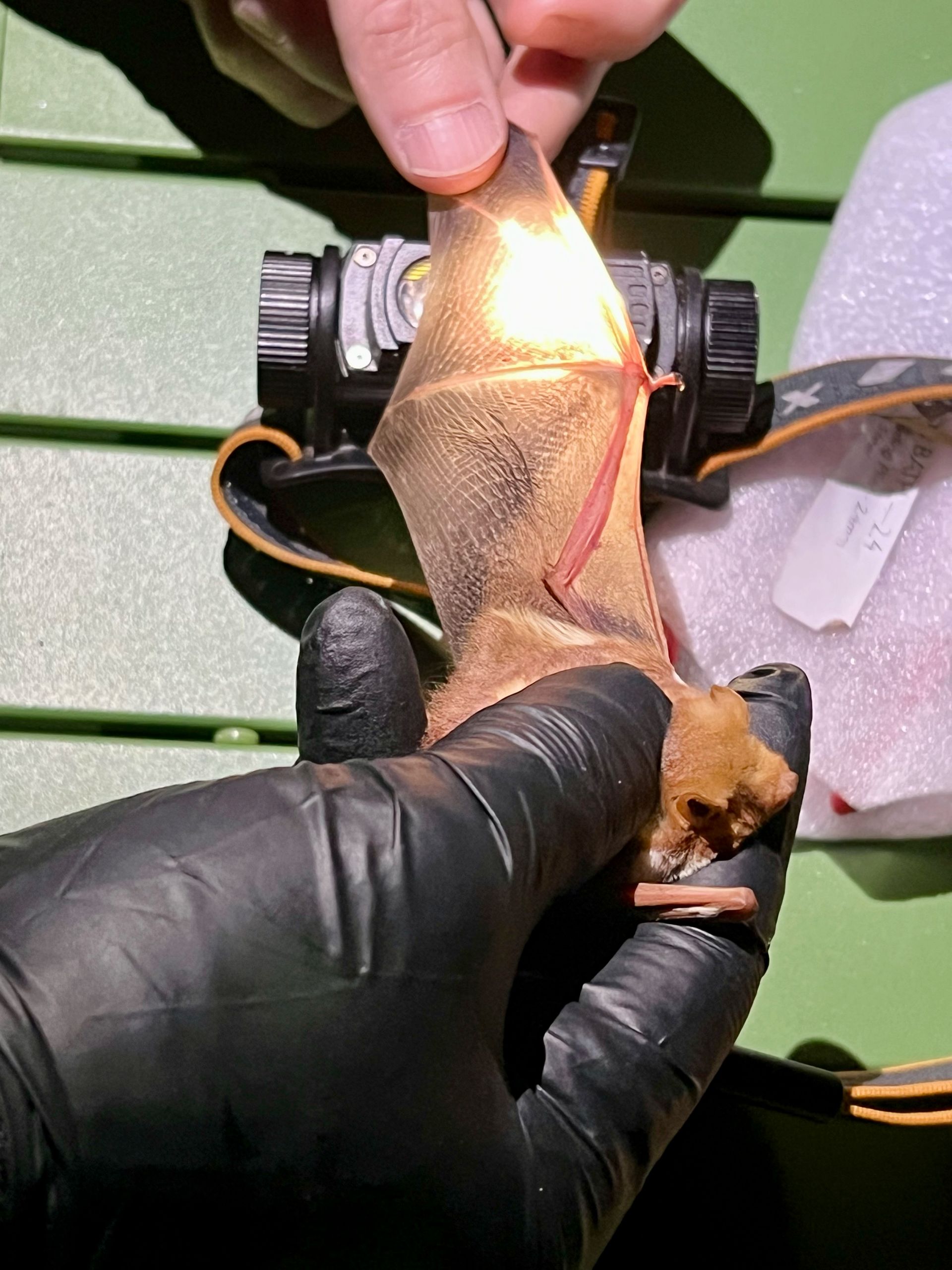
Mist-netting was conducted on the Etowah River and within the adjacent forested habitats. The riparian corridor and bottomland forest at this site represent high-quality bat foraging and commuting habitat, and the site's geographic position within the North Georgia Mountains places it within the ranges of multiple rare species, including the northern long-eared bat (Myotis septentrionalis), tricolored bat (Perimyotis subflavus), and gray bat (Myotis grisescens).
Educational Partnership
In addition to the scientific objectives, Volant structured the survey as a hands-on learning experience for UNG mammalogy students and faculty. Participants observed and assisted with net deployment, species identification, data recording, and net monitoring under the direct supervision of Volant's permitted biologists.
Beyond field techniques, Volant introduced students to the professional side of ecological consulting — what it looks like to conduct this type of work within a regulatory framework, what permits and training are required, and what career paths exist at the intersection of wildlife science and environmental consulting. For students considering careers in ecology or natural resources, the survey offered a direct window into what professional bat survey work entails.
Why this project matters
Baseline data are the foundation of all future wildlife management and conservation planning at a site. Before this survey, any question about bat use of the Hurricane Creek Research Site — which species are present, which habitats they prefer, whether federally listed species occur on the property — had no documented answer. That gap now has a scientific record attached to it.
For UNG, this baseline creates a foundation for future longitudinal monitoring, student research projects, and potential collaboration with the USFWS and Georgia Department of Natural Resources on species of conservation concern. For the bats themselves — particularly the riparian-associated species that depend on healthy creek corridors like Hurricane Creek and Etowah River — having documented occurrence data is the first step toward meaningful habitat stewardship.
About Volant EcoServices
Volant EcoServices is a woman-owned ecological consulting firm based in Kent, Ohio, specializing in bat research and permitting, threatened and endangered species surveys, habitat assessments, and wetland and stream delineations across the eastern United States. Co-founders Mary Gilmore and Dan Cox both hold active USFWS Section 10(a)(1)(A) Recovery Permits for Indiana bat, northern long-eared bat, and gray bat.
Learn about our bat survey services | Contact us about your project